Cloud-Clone Publishes Guide for Protein-Detection Platform Selection to Solve Common Laboratory Bottlenecks
Practical framework helps researchers select optimal assay platforms amid limited sample volume,low-abundance
Press Release Disclaimer: This is a press release distributed through the XPR Media network. It has not been independently verified by our newsroom.

Practical framework helps researchers select optimal assay platforms amid limited sample volume,low-abundance targets,instrument constraints and budget pressure
HUSTON, TX, UNITED STATES, October 14, 2026 /EINPresswire.com/ — Researchers frequently face frustrating experimental dilemmas: limited sample volume for multiple biomarker measurements, target proteins falling below assay detection thresholds, lack of specialised laboratory equipment, unavailable commercial panels for rare species or analytes, and tight research budgets. A small sample aliquot of only 50 μL may need testing for 20 cytokines. Biomarkers such as IL-4 in serum can remain undetectable even with neat sample loading. Precious biospecimens including cerebrospinal fluid may become nearly exhausted after a single ELISA run. In many such cases, poor platform selection, rather than operational error, creates experimental barriers.
Protein quantification represents one of the most routine laboratory workflows in life-science research. Nevertheless, many scientists inherit platform choices from prior lab practice. They only recognise mis-selection after samples are depleted, data shows poor stability, or project budgets are exceeded. Moving beyond abstract technical specifications, Cloud-Clone’s newly released guide centres on real-world pain points to support informed platform decision-making.
Pain Point 1: Limited sample volume for multi-analyte testing
Typical scenarios include mouse cerebrospinal fluid, bronchoalveolar lavage fluid, tear fluid and low-volume cell culture supernatant. These precious specimens may yield merely dozens of microlitres yet require measurement of numerous targets to map complete biological pathways.
Traditional ELISA imposes major limitations here. Each ELISA assay consumes 50-100 μL per analyte. Testing 20 targets would theoretically demand 1-2 mL sample even without technical replicates, which is impractical for scarce specimens.
For this challenge, Luminex or CBA multi-analyte platforms offer effective alternatives. Luminex enables simultaneous measurement of 2-100 analytes within one well, requiring only 10-50 μL sample input. CBA achieves detection of 5-30 analytes per well with 25-50 μL sample volume. Equivalent sample input delivers vastly higher analytical information output compared with ELISA.
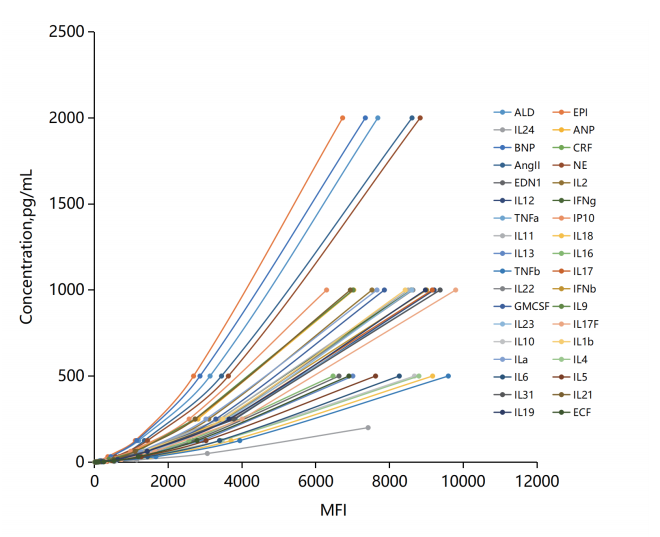
Figure 1 Standard curves for 36-analyte detection via Cloud-Clone multi-assay platform
Pain Point 2: Non-detectable low-abundance protein targets
Circulating IL-4 and IL-13 in healthy serum or early-stage neurodegeneration-associated cerebrospinal fluid biomarkers can exist at fg/mL concentration levels. Conventional ELISA cannot reach such low ranges and consistently returns “not detected” results.
Standard ELISA delivers typical sensitivity of 0.1-1 ng/mL, while conventional Luminex operates at pg-level sensitivity. Both platforms often fail for fg/mL-range analytes.
MSD ranks among the most sensitive immunoassay technologies available, reaching fg/mL-level sensitivity across a six-order-of-magnitude dynamic range. Its electrochemiluminescence chemistry generates low background signals and strong matrix-tolerance, permitting testing of serum, cerebrospinal fluid and other sample types without complex pre-processing. MSD is strongly recommended when target detectability becomes the primary experimental hurdle.
Pain Point 3: Absence of dedicated instrumentation for multi-analyte workflows
Many research groups operate under constrained budgets or run short-term multi-analyte projects and cannot justify purchasing specialised Luminex or MSD hardware.
CBA works with standard laboratory flow cytometers equipped with APC and PE channels and requires no additional capital equipment. Assay workflows complete within 3-4 hours, substantially faster than the 12-24-hour timeline for ELISA. Operators should note that CBA demands careful handling: insufficient micro-sphere vortexing causes bead aggregation, distorted population separation and invalid datasets, so adequate operator training is advised for new users.
Pain Point 4: Unavailable commercial panels for rare species or specialised analytes
Investigators studying less-common model organisms or measuring hormone-related and small-molecule targets often find fixed commercial panels cannot cover their required biomarkers.
Customisable assay solutions from suppliers such as Cloud-Clone resolve this gap. Cloud-Clone’s multi-analyte kits cover more than 10 species and over 7000 analytes. Researchers can freely combine 1-100 targets for custom panel assembly, with lead times of approximately three weeks for panels containing up to 30 analytes. Custom services provide practical solutions for rare species and specialised molecular targets poorly supported by off-the-shelf commercial offerings.
Pain Point 5: Tight budget requirements without compromising data quality
Research teams may face budget constraints while requiring reliable assay performance.
Modern multi-analyte solutions from leading suppliers deliver robust technical performance. Cloud-Clone supports both Luminex xMAP and flow-based CBA platforms. Validated performance data demonstrates assay recovery consistently falling within the acceptable 80%-120% range, serial-dilution linearity with R² ≥ 0.97, and intra-assay as well as inter-assay variance below 10%. These solutions deliver performance comparable with premium commercial products while offering competitive pricing and lead-times, making them suitable for budget-conscious laboratories pursuing dependable results.
Quick-reference overview of mainstream assay platforms
Figure 2 Quick-reference decision table for protein-detection platform selection
Platform selection should prioritise solving specific experimental challenges rather than simply adopting the most technically advanced option. Researchers facing sample scarcity should evaluate multi-analyte systems. For low-concentration targets, MSD represents a powerful option. Where specialised instruments are unavailable, CBA provides a practical entry point. Custom assay services from Cloud-Clone address gaps for rare-species and niche biomarker research.
A proven experimental strategy combines screening and validation workflows: use CBA or Luminex for broad multi-analyte screening to identify candidate biomarkers, then apply MSD or ELISA for targeted confirmation. This approach balances cost control and data reliability.
Before finalising platform choices, researchers are encouraged to identify their most pressing experimental bottleneck — this critical insight points toward the most appropriate assay solution.
Researchers frequently face frustrating experimental dilemmas: limited sample volume for multiple biomarker measurements, target proteins falling below assay detection thresholds, lack of specialised laboratory equipment, unavailable commercial panels for rare species or analytes, and tight research budgets. A small sample aliquot of only 50 μL may need testing for 20 cytokines. Biomarkers such as IL-4 in serum can remain undetectable even with neat sample loading. Precious biospecimens including cerebrospinal fluid may become nearly exhausted after a single ELISA run. In many such cases, poor platform selection, rather than operational error, creates experimental barriers.
Protein quantification represents one of the most routine laboratory workflows in life-science research. Nevertheless, many scientists inherit platform choices from prior lab practice. They only recognise mis-selection after samples are depleted, data shows poor stability, or project budgets are exceeded. Moving beyond abstract technical specifications, Cloud-Clone’s newly released guide centres on real-world pain points to support informed platform decision-making.
Pain Point 1: Limited sample volume for multi-analyte testing
Typical scenarios include mouse cerebrospinal fluid, bronchoalveolar lavage fluid, tear fluid and low-volume cell culture supernatant. These precious specimens may yield merely dozens of microlitres yet require measurement of numerous targets to map complete biological pathways.
Traditional ELISA imposes major limitations here. Each ELISA assay consumes 50-100 μL per analyte. Testing 20 targets would theoretically demand 1-2 mL sample even without technical replicates, which is impractical for scarce specimens.
For this challenge, Luminex or CBA multi-analyte platforms offer effective alternatives. Luminex enables simultaneous measurement of 2-100 analytes within one well, requiring only 10-50 μL sample input. CBA achieves detection of 5-30 analytes per well with 25-50 μL sample volume. Equivalent sample input delivers vastly higher analytical information output compared with ELISA.
Figure 1 Standard curves for 36-analyte detection via Cloud-Clone multi-assay platform
Pain Point 2: Non-detectable low-abundance protein targets
Circulating IL-4 and IL-13 in healthy serum or early-stage neurodegeneration-associated cerebrospinal fluid biomarkers can exist at fg/mL concentration levels. Conventional ELISA cannot reach such low ranges and consistently returns “not detected” results.
Standard ELISA delivers typical sensitivity of 0.1-1 ng/mL, while conventional Luminex operates at pg-level sensitivity. Both platforms often fail for fg/mL-range analytes.
MSD ranks among the most sensitive immunoassay technologies available, reaching fg/mL-level sensitivity across a six-order-of-magnitude dynamic range. Its electrochemiluminescence chemistry generates low background signals and strong matrix-tolerance, permitting testing of serum, cerebrospinal fluid and other sample types without complex pre-processing. MSD is strongly recommended when target detectability becomes the primary experimental hurdle.
Pain Point 3: Absence of dedicated instrumentation for multi-analyte workflows
Many research groups operate under constrained budgets or run short-term multi-analyte projects and cannot justify purchasing specialised Luminex or MSD hardware.
CBA works with standard laboratory flow cytometers equipped with APC and PE channels and requires no additional capital equipment. Assay workflows complete within 3-4 hours, substantially faster than the 12-24-hour timeline for ELISA. Operators should note that CBA demands careful handling: insufficient micro-sphere vortexing causes bead aggregation, distorted population separation and invalid datasets, so adequate operator training is advised for new users.
Pain Point 4: Unavailable commercial panels for rare species or specialised analytes
Investigators studying less-common model organisms or measuring hormone-related and small-molecule targets often find fixed commercial panels cannot cover their required biomarkers.
Customisable assay solutions from suppliers such as Cloud-Clone resolve this gap. Cloud-Clone’s multi-analyte kits cover more than 10 species and over 7000 analytes. Researchers can freely combine 1-100 targets for custom panel assembly, with lead times of approximately three weeks for panels containing up to 30 analytes. Custom services provide practical solutions for rare species and specialised molecular targets poorly supported by off-the-shelf commercial offerings.
Pain Point 5: Tight budget requirements without compromising data quality
Research teams may face budget constraints while requiring reliable assay performance.
Modern multi-analyte solutions from leading suppliers deliver robust technical performance. Cloud-Clone supports both Luminex xMAP and flow-based CBA platforms. Validated performance data demonstrates assay recovery consistently falling within the acceptable 80%-120% range, serial-dilution linearity with R² ≥ 0.97, and intra-assay as well as inter-assay variance below 10%. These solutions deliver performance comparable with premium commercial products while offering competitive pricing and lead-times, making them suitable for budget-conscious laboratories pursuing dependable results.
Quick-reference overview of mainstream assay platforms
Figure 2 Quick-reference decision table for protein-detection platform selection
Platform selection should prioritise solving specific experimental challenges rather than simply adopting the most technically advanced option. Researchers facing sample scarcity should evaluate multi-analyte systems. For low-concentration targets, MSD represents a powerful option. Where specialised instruments are unavailable, CBA provides a practical entry point. Custom assay services from Cloud-Clone address gaps for rare-species and niche biomarker research.
A proven experimental strategy combines screening and validation workflows: use CBA or Luminex for broad multi-analyte screening to identify candidate biomarkers, then apply MSD or ELISA for targeted confirmation. This approach balances cost control and data reliability.
Before finalising platform choices, researchers are encouraged to identify their most pressing experimental bottleneck — this critical insight points toward the most appropriate assay solution.
SuKi Duan
CLOUD-CLONE CORP.WUHAN
email us here
Visit us on social media:
LinkedIn
Instagram
TikTok
X
Legal Disclaimer:
EIN Presswire provides this news content “as is” without warranty of any kind. We do not accept any responsibility or liability
for the accuracy, content, images, videos, licenses, completeness, legality, or reliability of the information contained in this
article. If you have any complaints or copyright issues related to this article, kindly contact the author above.

Media gallery