AI in Drug Discovery Market to reach USD 23.95 Billion by 2035 at 23.9% CAGR
AI in Drug Discovery Market to Surge from USD 3.48 Bn in 2026 to USD 23.95 Bn by 2035-By Escalating Drug Development
Press Release Disclaimer: This is a press release distributed through the XPR Media network. It has not been independently verified by our newsroom.

AI in Drug Discovery Market to Surge from USD 3.48 Bn in 2026 to USD 23.95 Bn by 2035-By Escalating Drug Development Cost, Exponential Growth in Biomedical Data
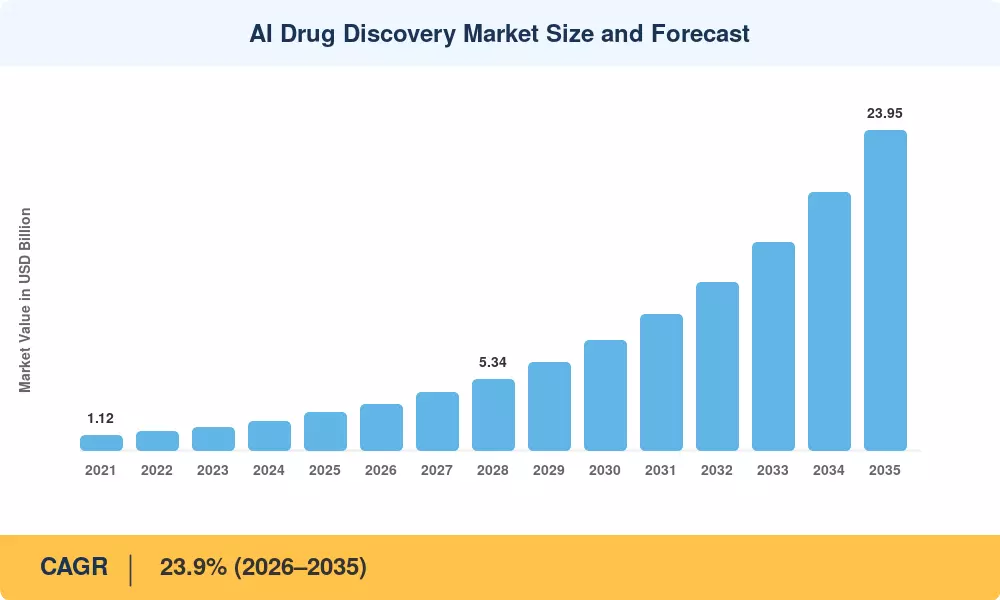
NY, CA, UNITED STATES, September 17, 2026 /EINPresswire.com/ — The global AI in Drug Discovery Market size is projected to reach USD 23.95 Billion by 2035 from USD 3.48 Billion in 2026, at a CAGR of 23.9% during the forecast period 2026–2035. The market base was estimated at USD 2.81 Billion in 2025.
The 23.9% CAGR—anchored by structural shifts in pharmaceutical R&D—is propelled by three converging forces: escalating drug development costs, with the average cost of bringing a single drug to market now exceeding USD 2.6 billion, positioning AI platforms as the most direct answer to this unsustainable trajectory; exponential growth in biomedical data, as advances in genomics, proteomics, and multi-omic evidence generate large, high-quality, AI-ready datasets that form the foundation of machine learning models; and pharma-AI strategic partnerships, with more than USD 5.8 billion committed between 2022 and 2024, as Pfizer, Roche, and AstraZeneca each build dedicated in-house AI labs.
Global pharmaceutical companies and health organizations are amplifying this momentum. Insilico Medicine operates its end-to-end Pharma.AI platform and advanced the first AI-designed drug into Phase II clinical trials. Schrödinger continues to lead hybrid physics-AI discovery through its LiveDesign and FEP+ platforms. According to U.S. FDA data, regulators accepted over 300 AI-assisted submissions during 2023–2024 alone, while the NIH allocated USD 1.8 billion to AI-related health research grants during fiscal year 2024, a 34% increase from the prior year. These forces are creating the computational infrastructure and R&D demand on which the AI in Drug Discovery Market depends.
Request A Free Sample:
https://www.marketresearchfuture.com/sample_request/9393
Key Market Trends & Growth Drivers
Escalating Drug Development Costs
The market is witnessing mounting pressure from the rising cost of pharmaceutical innovation. The average cost to advance a medicine from discovery to launch has climbed steadily, and AI platforms are increasingly being deployed to cut preclinical timelines—typically by 30–40%—and improve the return on investment for pharmaceutical R&D. This trend indicates a shift in industry attitudes toward proactive computational R&D, with AI being recognized for its dual benefits of cost reduction and accelerated candidate selection. Schrödinger continues advancing hybrid physics-AI platform development through sustained product innovation in molecular simulation.
Exponential Growth in Biomedical Data
Innovations in data generation are becoming a hallmark of the industry. Thanks to developments in proteomics, genomics, and empirical evidence, the volume and complexity of biological data are growing at a rate never seen before. The NIH’s All of Us Research Program and related international programs are producing large, high-quality, AI-ready datasets that form the basis of machine learning models. Software solutions accounted for approximately 62% of market revenue in 2025, driven by platform adoption across preclinical and clinical phases.
Government AI-Healthcare Funding Programs
The incorporation of public-sector funding into the industry is gaining traction. The U.S. National Institutes of Health allocated USD 1.8 billion to AI-related health research grants during fiscal year 2024, a 34% increase from the prior year. China’s Ministry of Science and Technology committed RMB 12 billion (approximately USD 1.7 billion) to its AI-pharma industrial development plan through 2027. Recursion Pharmaceuticals continues investing in autonomous lab-AI integration and phenomics, operating semi-autonomous wet-lab-robotic platforms.
Pharma-AI Strategic Partnerships
The rising volume of alliances between pharmaceutical and AI-native companies is a primary driver. Between 2022 and 2024, over 180 strategic partnerships were signed between top-20 pharmaceutical companies and AI-native drug discovery firms, with total deal value exceeding USD 5.8 billion. The market is projected to expand as healthcare providers increasingly deploy AI platforms to manage the earliest and most failure-prone stages of the pipeline. Sanofi’s USD 1.2 billion multi-year collaboration with Insilico Medicine and AstraZeneca’s partnership with Absci exemplify how these alliances create recurring revenue streams for AI platform providers.
Ask for Customization:
https://www.marketresearchfuture.com/ask_for_customize/9393
Market Segment Insights
BY COMPONENT
Largest segment with 62% share in 2025, driven by platform licensing for virtual screening and molecular generation. Insilico Medicine continues expanding software platform adoption through sustained product innovation across its Pharma.AI suite.
Fastest-growing segment, growing at a CAGR of 26.1%, reflecting the shift toward managed AI analytics among mid-tier pharmaceutical companies.
BY TECHNOLOGY
Machine learning holds the dominant position in the AI in Drug Discovery Market, representing a 28.2% CAGR through 2035, powering applications from AlphaFold-style protein-structure prediction to generative adversarial networks for de novo molecular design.
Natural language processing is gaining traction in biomedical literature mining and adverse-event extraction, while computer vision applications are expanding in histopathology image analysis and high-content screening.
BY APPLICATION
Largest segment with 34% share in 2025, due to multi-omic data integration for novel target discovery and the industry’s prioritization of de-risking the earliest pipeline stages.
Hit & Lead Generation: Significant share at 27% in 2025, as generative chemistry and virtual screening enable preclinical candidate selection in months rather than years.
Preclinical Development: Significant share at 22% in 2025, driven by ADMET prediction and toxicity modeling across preclinical workflows.
Clinical Trial Optimization: Smaller but significant share at 17% in 2025, reflecting growing adoption of AI in patient stratification and clinical-trial site selection.
BY DEPLOYMENT
Dominant route with 64% share in 2025, offering scalability, collaboration, and lower upfront cost for large-scale molecular simulations.
Preferred by top-10 pharmaceutical companies with strict data-sovereignty and IP-protection requirements, positioning itself as a secure alternative for companies handling sensitive proprietary molecular data.
Read Detailed Insights:
https://www.marketresearchfuture.com/reports/ai-drug-discovery-market-9393
Regional Outlook
North America — Market Leader in Innovation
North America leads with approximately 42% of global market share, generating around USD 1.18 billion in 2025 revenue. The region’s growth is driven by the density of biotech startups and NIH funding pipelines, with the Boston-Cambridge corridor and San Francisco Bay Area housing over 65% of venture-funded AI-pharma startups. The competitive landscape is characterized by continuous innovation and strategic partnerships among leading pharmaceutical and AI-platform companies.
Europe — Second Largest Market
Europe holds roughly 28% of the global market, anchored by the UK’s life-sciences superpower agenda and France’s Health Data Hub initiative. The region benefits from increasing awareness of AI-augmented R&D and supportive healthcare policies. Regulatory bodies like the EMA are actively facilitating AI-specific submission frameworks, with the FDA and EMA jointly releasing formal Guiding Principles of Good AI Practice in Drug Development. Leading countries include Germany, the United Kingdom, and France, where major pharmaceutical companies such as AstraZeneca and Sanofi are heavily invested.
Asia-Pacific — Rapidly Growing Market Segment
The Asia-Pacific region is the fastest-growing, expanding at a CAGR of 27.4% and projected to reach USD 6.21 billion by 2035. The growth is powered by China’s AI-pharma industrial policy, India’s growing CRO ecosystem, and Japan’s AMED regenerative medicine AI programs. Countries like China and India are experiencing a surge in demand, supported by government initiatives such as China’s RMB 12 billion AI-driven biopharmaceutical allocation and India’s BIRAC grants totaling USD 280 million since 2022. The competitive landscape is evolving with companies like Insilico Medicine and a wave of over 60 AI-drug discovery startups founded in China since 2021 leading the charge.
Middle East and Africa — Untapped Potential
The MEA region holds around 5% of the global share, driven by increasing awareness of AI in healthcare, coupled with rising healthcare investments. Countries like Saudi Arabia and the UAE are leading the way through the Dubai Health Authority’s AI regulatory sandbox, Abu Dhabi’s G42 Healthcare investments, and Saudi Arabia’s Vision 2030 biotech cluster, with a growing presence of international pharmaceutical and technology companies.
Competitive Landscape and Recent Developments
The AI in Drug Discovery Market is characterized by intense competition and rapid growth, driven by escalating R&D costs and exponential biomedical data growth worldwide. The global industry exhibits medium concentration with an estimated HHI of approximately 850, while the top five companies hold a combined estimated share of 28–35%.
KEY COMPANIES AND RECENT MILESTONES
Insilico Medicine (HK): operates its end-to-end Pharma.AI platform with generative chemistry and a clinical pipeline, holding an estimated 5–8% revenue share. Advanced the first AI-designed drug into Phase II clinical trials.
NVIDIA (US) (January 2026): Announced a significant extension of NVIDIA BioNeMo, an open development platform that allows lab-in-the-loop operations to create innovations in drug discovery and AI-driven biology. Also announced with Eli Lilly and Company the creation of a first-of-its-kind AI co-innovation lab in January 2026.
BenevolentAI (GB) (August 2023): Initiated Phase I trials for BEN-8744, an AI-identified PDE10 inhibitor for ulcerative colitis, representing the company’s first wholly AI-discovered candidate entering clinical development.
Atomwise Inc. (US) (August 2022): Signed a strategic multi-target research collaboration with Sanofi for AI-powered drug discovery, leveraging its AtomNet platform for computational discovery and research of up to five drug targets.
Other Key Players: Schrödinger (US), Recursion Pharmaceuticals (US), Exscientia (GB), BenevolentAI (GB), AbCellera Biologics (CA), Google DeepMind (GB), Absci Corporation (US).
Future Outlook: 2026–2035
The AI in Drug Discovery Market is projected to reach USD 23.95 billion by 2035, growing at a CAGR of 23.9%, driven by escalating drug development costs, exponential biomedical data growth, and pharma-AI strategic partnerships.
New opportunities lie in:
Expansion into emerging markets in India and China with tailored AI-discovery platforms
Development of AI-powered rare disease drug discovery targeting the 7,000 known rare diseases affecting 300 million people globally
Investment in AI-as-a-Service platforms for mid-tier pharmaceutical companies
By 2035, the AI in Drug Discovery Market is expected to achieve substantial growth and innovation.
More Related Research Insights:
https://www.marketresearchfuture.com/zh-cn/reports/anti-ageing-drugs-market-3504
https://www.marketresearchfuture.com/ko/reports/anti-ageing-drugs-market-3504
https://www.marketresearchfuture.com/fr/reports/bioanalytical-testing-services-market-6573
https://www.marketresearchfuture.com/ja/reports/bioanalytical-testing-services-market-6573
https://www.marketresearchfuture.com/de/reports/bioanalytical-testing-services-market-6573
https://www.marketresearchfuture.com/es/reports/bioanalytical-testing-services-market-6573
https://www.marketresearchfuture.com/zh-cn/reports/bioanalytical-testing-services-market-6573
https://www.marketresearchfuture.com/ko/reports/bioanalytical-testing-services-market-6573
https://www.marketresearchfuture.com/fr/reports/cell-therapy-market-5066
https://www.marketresearchfuture.com/ja/reports/cell-therapy-market-5066
https://www.marketresearchfuture.com/de/reports/cell-therapy-market-5066
https://www.marketresearchfuture.com/fr/reports/chemotherapy-market-5791
https://www.marketresearchfuture.com/ja/reports/chemotherapy-market-5791
https://www.marketresearchfuture.com/de/reports/chemotherapy-market-5791
https://www.marketresearchfuture.com/fr/reports/contact-lenses-market-6210
Market Research Future
Market Research Future
+1 855-661-4441
email us here
Legal Disclaimer:
EIN Presswire provides this news content “as is” without warranty of any kind. We do not accept any responsibility or liability
for the accuracy, content, images, videos, licenses, completeness, legality, or reliability of the information contained in this
article. If you have any complaints or copyright issues related to this article, kindly contact the author above.

Media gallery